
3/3, 5/5, 7/7. The very easy to remember dates of three of Japan’s most popular traditional holidays. (1/1 for New Year’s Day follows the pattern, but is not traditional. Also there’s one on 9/9, but most people seem to ignore it). March 3rd is Hinamatsuri, called Doll’s Festival or Girls’ Day in English (boys get their day in May).
The Past
Hinamatsuri, like many traditional Japanese holidays, originally came from China hundreds of years ago where it was something totally different. Originally, you would make paper dolls/effigies to rub on your body and breathe on that would take away all the bad mojo, then send them down the river. Over time, similar paper dolls became popular toys for young girls. These two things gradually combined, making the day less a purification ritual and more of a celebration of women.
Then a few hundred years later in 1629, the princess at the time (Princess Meisho) became empress. Empresses weren’t allowed to get married, so her mother made a display of her as a doll in a happy marriage. Since royals were the og influencers, these displays exploded in popularity. Families made more and more elaborate heirloom dolls and it got to the point where the government had to tell them to chill out, banning “excessive luxury.” The dolls were (and are) said to keep away bad luck and used to wish for a healthy future and a happy eventual wedding.
The Present
Unlike Setsubun, there’s not much of an event on the actual day. However, in the weeks leading up to it, families with daughters will set up the special displays in their homes. Families with very young daughters also need to set up a fence around said display because toddlers are very destructive and stop throwing things into the fenced area where you can’t reach them! Those are just to look at, not to play with. That’s the problem with most decorative holidays. “Hey, see that brightly colored thing that looks like a toy? Well, it’s super fragile, so don’t ever touch it.”
Current displays can range to a simple platform up to a seven-step display. At the top are generally two dolls – an emperor and empress – in traditional Heian (794-1185 AD) wedding kimonos. A full 7-tiered display will then have 2-3 court ladies, five court musicians, three servants/guards, two attendants and a partridge in a pear tree the bride’s dowry set and procession tools in that order (except the attendants and guards, who I switched for the obvious joke). Each one has their own little accessories that were used in traditional weddings and every year I have to look up a Youtube video to remember what goes where. Then another video that reminds me which box everything goes in and how it needs to be wrapped. It even came with a duster and white gloves for keeping it super clean. Also, if you don’t take it down the day after Hinamatsuri, you have to turn them facing away from you. I don’t remember exactly why, but Maki told me to do it.
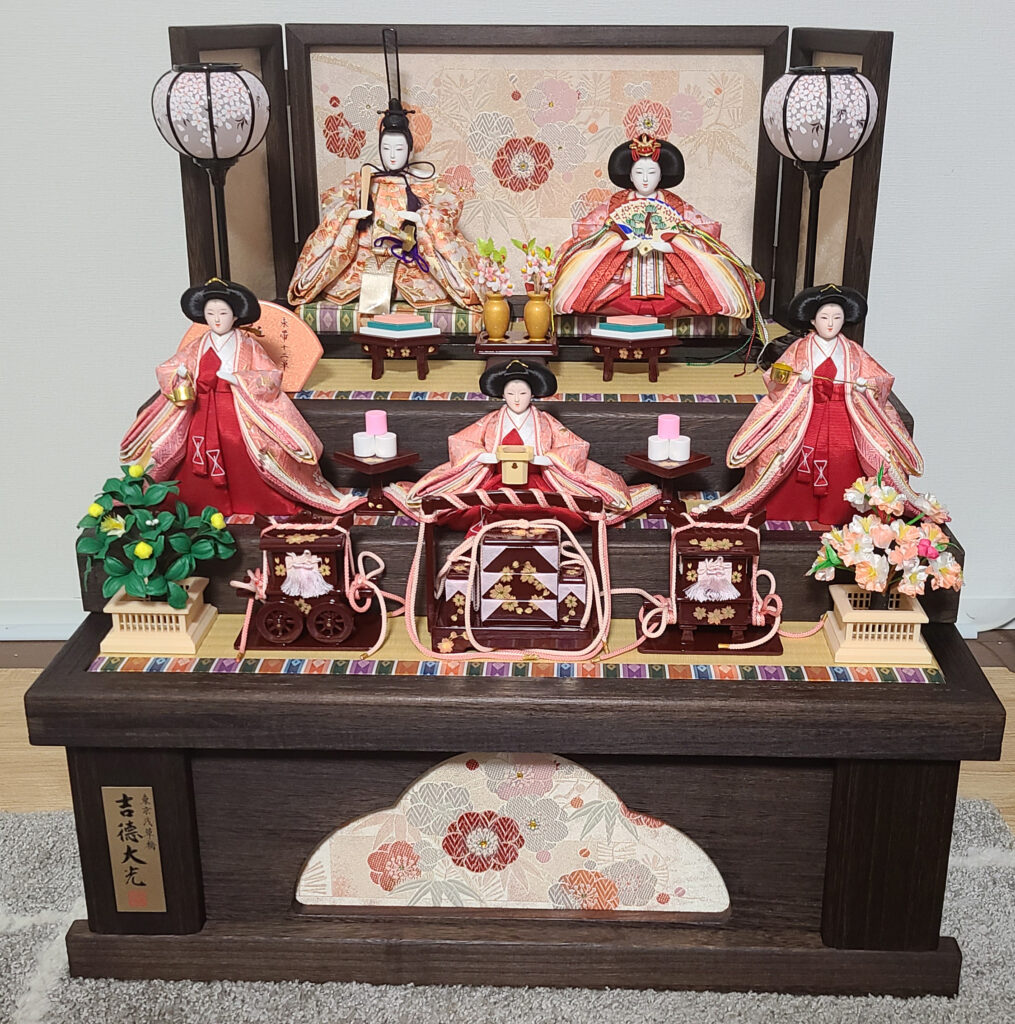
Maki very much wanted 5 or 7 tiers, but alas our tiny Japanese apartment doesn’t have room. Which is also good because I had more than 7 tears seeing that price (400-500k yen, which nowadays is a bit over $3k due to the terrible exchange rate). Not to mention having to set that whole thing up every year. We settled for 3 tiers which I think was about $1.5k. There are a number of stores that ONLY sell these and the Children’s Day (5/5) samurai armor/helmets. We bought it around the time Chisaki was born. It’s like buying a new car. There’s the displayed price, then the price that they offer, then the final price they give you after “checking with the manager” and adding in a few add-ons. I cannot recommend learning a foreign language enough if just to talk about things in front of the sales person without them knowing what’s up. A lot of these dolls are handmade, and the sales lady would give long explanations that these ones are more expensive because of the way it was made or the materials or whatever. I correctly guessed that I wouldn’t remember or be able to tell anyway, so that didn’t really factor in.
Nowadays it is also said that each girl should be bought their own hina dolls rather than pass them down as they are meant to be a substitute for that one girl to absorb her bad luck. Gee, I wonder who came up with that part of the tradition? Now there are limits to how much misfortune they can take on? Sounds like planned obsolescence to me.
How long did it take before I took those decorations down? Who made the paper cup dolls in the cover image? (J) What do I do with them now because they’re cute and a good memory but they’re kind of big and they don’t fit in the box with the rest of the things? Find out on the next episode of the Gaijin Chronicles! Dah dahh dadahhh da dahh duuhhh.
More photos can be viewed here. Just request permission if unable to access.
Discover more from The Gaijin Chronicles Returns
Subscribe to get the latest posts sent to your email.